This is sort of a sequel to my post on Inis Beag, the most sexually repressed society in the world. If you want to check that out, it is HERE.
The culture that is on the other end if the spectrum is very different. Between Australia and South America in the Pacific Ocean is a cluster of islands called the Cook Islands. The most southern of them is Mangaia, the most sexually liberated culture in the world. In the 1970s, Donald S. Marshall studied Mangaia and learned that sex was to them the way that money, religion or football is to Americans. Mangaians not only cared about and approved of sex but they encouraged sex, as much of it with as many different partners as possible at an early age. The complete opposite of Inis Beag. Marshall observed that at age 4 boys and girls who once ran around naked together were integrated into sexual segregation. Boys, men, brothers, husbands on one side, girls, sisters, women, wives on the other. All separated. They'd all go to events together and sleep in one big open room, but on different sides.
Around age 7,8,9,10 boys learn about masturbation and tried it frequently but not too much. Once puberty began, determined by pubic hair and a retractable foreskin, boys would then undergo super-incision, which was when the father would invite an expert or sometimes two to take his son some place secluded like the beach or a mountain stream and there make a lateral incision along the top of his penis as far up as the stomach. In the next two weeks, while the cut healed the expert would teach the boy, now a man, how to pleasure women. Lessons in cunnilingus, breast suckling, serial orgasms, and simultaneous orgasms. then the new man would be paired with an older woman who would run him through the practice sessions, which would include penetration, at which point she would remove the lateral incision scab with her vagina. This is definitely squirm-inducing. Take a deep breath.
Girls also masturbated as children. For them, it was by pressing their thighs together or rocking on their heels. As they aged, girls also received instructions from older mentors about how to orgasm. With orgasm then being such a given for all parties, the goal of sex is then endurance and matched reactions. In Marshall's words, ultimate sex was when the men's orgasm "is achieved simultaneously with the peak of his partner's pleasure". How did this happen though with the separation of the sexes? Systems, nonverbals. They'd figure out ways quickly because now that they were trained, sex was like a competition. Who could have the most sex with the most partners and be the most satisfying? Often a young man investigated beforehand how he could sneak into the open space room where the girls slept with her entire family. Ideally, he'd reach her and she'd be into it. Her parents wouldn't wake or they'd listen silently for their daughter's pleasure and hope for marriage. Sometimes, she would expect to be coaxed, like sweet talk, which put him at risk for breaking segregation code. Other times, if he was rejected or rushed, he'd try by force. Even the most sexually liberated culture has a relationship with sexual violence. Let's say the girl is enthusiastic about her night visitor, though. She'll date him for a while, then another guy and another guy, because she's told that the more partners that she has, the less likely it is for her to get pregnant. Pregnancy supposedly comes from spending too much time with the same person. Typically, she will get pregnant, which is traditionally the move to marriage and monogomy-ish and more babies.
What else might you find interesting about Mangaia? Out of 2,000 on the islands there are a few noted to be intersex or what we might call trans. There is no known use of sex toys, with the exception of a pillow sometimes used to prop up the women's hips. The greatest cultural fear is "tiramate", translated to "dead penis" or impotence. Although there is sex contact between youth and mentors, homosexuality was not considered present on Mangaia at the time of this study. Sex there was and may still be the way they communicate, earn prestige, a sense of identity.
Monday, January 23, 2017

The Most Sexually Conservative Society in the World
Not everybody's experience is the same, and if somebody's experience is not the same as your own, that does not make you right and them wrong. This may seem obvious, but sometimes diversity can be quite extreme. On one end of the spectrum is Inis Beag, which anthropologists consider the most sexually repressed society in the world. I call it Inis Beag because that it the name that researchers gave it to protect the cultures' anonymity. To give you some geographical context, Inis Beag is a small island off the coast of southern Ireland. Cultural anthropologist John C. Messenger researched this community for many years and observed most notably how taboo sexuality was there. Taboo: Adj, prohibited or restricted by social custom.
Before I describe in detail what this entails, I want to explain the use of past tense. Messenger's research, while extensive, was completed in the 1950s and 60s. A lot of things can change in 50 years, especially with the advent of the Internet. In these days, circa 1966, was a rural community of 350 people, primarily a farming lifestyle. Their beliefs around sex were that it was dangerous and unhealthy. Many people wished to not participate in sex at all, but marriage, arranged by parents, named it a duty. Dutiful sex happened between married adults and some relationships strictly for procreation. They used the "man on top" position, during which participants wore smocks to cover as much skin as possible while trying to finish as soon as possible. Foreplay was limited to light kissing and mild groping of the buttocks. No heavy petting, no oral sex. They probably did have anal sex, but unintentionally as a result of anatomical ignorance. Masturbation was taboo. Exploration of bodies, their own or others was taboo. Sex talk was taboo. If people were sexually expressive in public, they were severely punished. Dogs licking their genitals were beaten.
The people of Inis Beag grew up without education, language, or permission to understand their natural experiences of sexuality, and as a result, experiences like menstruation, childbirth, and menopause were terrifying. Imagine you are bleeding. You don't know why you are bleeding, but blood is coming from a place that you don't know about because you don't touch it and you don't discuss it. Imagine pregnancy and childbirth. Imagine parenting an infant that needs affection, which you are unaccustomed to giving because being intimate is discouraged. Typical menopause symptoms: hot flashes, night terrors, hair loss, weight loss, cramps, and the end of menstruation were equated with disease. This meant that some Inis Beag women climbed into bed at 40 and didn't leave until their death. I am not saying that this is the same way of life as people who are living there now. I would love to visit and report back on their present sexuality.
Before I describe in detail what this entails, I want to explain the use of past tense. Messenger's research, while extensive, was completed in the 1950s and 60s. A lot of things can change in 50 years, especially with the advent of the Internet. In these days, circa 1966, was a rural community of 350 people, primarily a farming lifestyle. Their beliefs around sex were that it was dangerous and unhealthy. Many people wished to not participate in sex at all, but marriage, arranged by parents, named it a duty. Dutiful sex happened between married adults and some relationships strictly for procreation. They used the "man on top" position, during which participants wore smocks to cover as much skin as possible while trying to finish as soon as possible. Foreplay was limited to light kissing and mild groping of the buttocks. No heavy petting, no oral sex. They probably did have anal sex, but unintentionally as a result of anatomical ignorance. Masturbation was taboo. Exploration of bodies, their own or others was taboo. Sex talk was taboo. If people were sexually expressive in public, they were severely punished. Dogs licking their genitals were beaten.
The people of Inis Beag grew up without education, language, or permission to understand their natural experiences of sexuality, and as a result, experiences like menstruation, childbirth, and menopause were terrifying. Imagine you are bleeding. You don't know why you are bleeding, but blood is coming from a place that you don't know about because you don't touch it and you don't discuss it. Imagine pregnancy and childbirth. Imagine parenting an infant that needs affection, which you are unaccustomed to giving because being intimate is discouraged. Typical menopause symptoms: hot flashes, night terrors, hair loss, weight loss, cramps, and the end of menstruation were equated with disease. This meant that some Inis Beag women climbed into bed at 40 and didn't leave until their death. I am not saying that this is the same way of life as people who are living there now. I would love to visit and report back on their present sexuality.
Wednesday, July 13, 2016
You've Come a Long Way, Baby!: Women and Airplane Ads
It may come as a surprise that women have been included in
airline advertisements since the invention of airline advertising. Back in the 1920s, when it was more common
for people to purchase their own planes, famous female aviators would show up
in newspaper ads, proving that the planes were so easy to operate that even a
woman could fly them. However, the days
of “A girdle to set you free” style advertising is long gone, right?
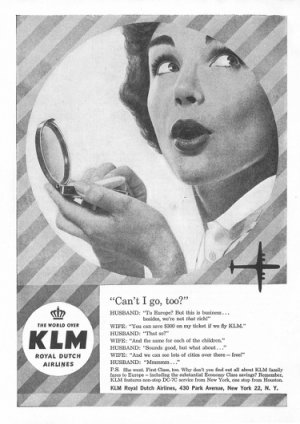
The 1960s, however, saw the birth of one of the most
enduring tropes in all of marketing: the Sexy Flight Attendant. In the early 60s the trope was relatively
tame. Airlines had stringent rules about
which girls would be acceptable stewardesses based on their age, sex, weight,
height, marital status, etc… That meant
that the ones who were actually hired were basically pre-approved marriage
material. The airlines taught them to
cook, clean, and make cocktails. What
more could a single man ask for?

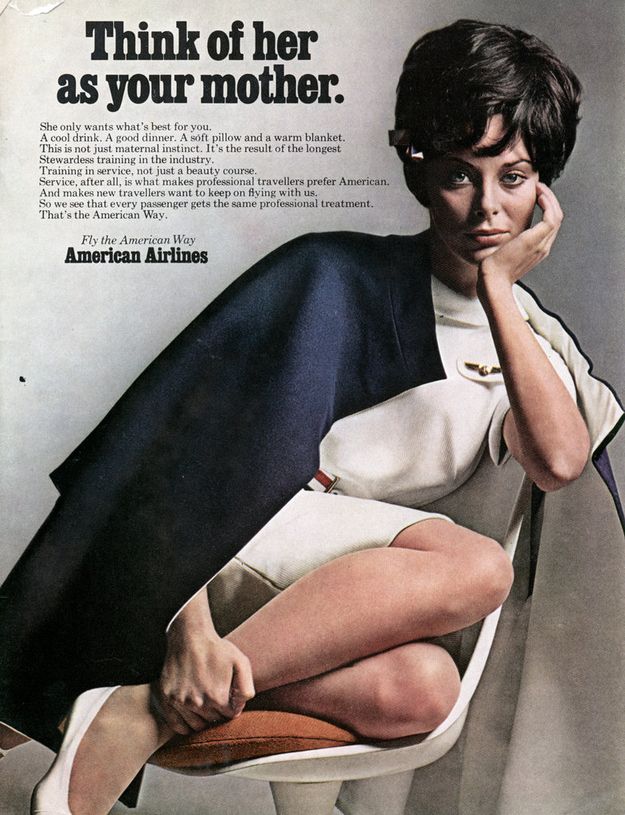
As the 1960s wore on, the advertisements got raunchier, but
the second wave feminist movement was also underway. This came to a head with the notorious “Fly
Me” campaign put forth by the now-extinct National Airlines. The campaign ran in 1971 and cost the company
$9.5 million. The campaign featured five
stewardesses (Cheryl, Jo, Margie, Linda, and Laura) introducing themselves and
requesting for the readers to “fly them”.
Millions of people flew Cheryl last year. And you can fly Laura all the way to Miami! It was more than billboard ads, though. National Airlines also painted the names of
the women on the front of their planes and made their stewardesses wear “Fly
Me” buttons while on the job. The
National Organization of Women tried to shut the ad campaign down with an
injunction and in response, National Airlines changed their tactics. Now the ads featured the stewardesses
“looking seductively into the camera and breathing ‘I’m going to fly you like
you’ve never been flown before’”.
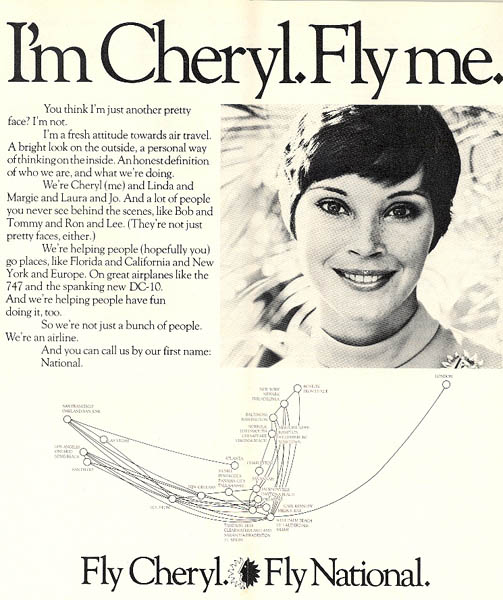
However, actual real-life Cheryl Fioravanti saw no problem
with the ad. The National Organization
of Women only protested harder when a quote from Cheryl came out saying, “I’m
afraid I don’t agree with the women’s liberation very much. I don’t think that
household chores should be shared. I like to be in the kitchen and I like to
have Gene in charge of paying the bills.”
Unfortunately, despite the fact that the flight attendant
profession has made leaps and bounds in the past few decades when it comes to
gender equality and portrayal, “sex sells” remains a prominent idea in airline
advertising.
Air Asia, a low cost Malaysian airline, recently released an
ad that makes it feel like nothing has changed.

The discount airline Spirit Airlines is making ads that feel
more like they are for Axe Body Spray than airlines. (I actually had to search
just to find one that was appropriate enough to show.)

Even Southwest Airlines has started pasting Sports
Illustrated swimsuit models on the sides of some of their planes.

It looks like it’s going to be a while before anything
changes, so perhaps it’s better to just put on your apron, grab your Virginia
Slims and BIC “For Her” pens, and head for the nearest emergency exit. Thanks for flying with us.
Bibliography
"13 Sexist Vintage Airline Ads That Are Even Worse Than
You'd Think." Vox. 07 Aug. 2015.
Web. 29 Apr. 2016.
<http://www.vox.com/2015/8/7/9113743/vintage-sexist-airline-ads>.
"ADVERTISING: Fly Me Again." Time. Time Inc., 24 June 1974. Web. 01 May 2016. <http://content.time.com/time/magazine/article/0,9171,944906,00.html>.
"The Groovy Age of Flight: A Look at Stewardesses of
the 1960s-70s - Flashbak." Flashbak
The Groovy Age of Flight A Look at Stewardesses of the 1960s70s Comments.
2015. Web. 01 May 2016.
<http://flashbak.com/the-groovy-age-of-flight-a-look-at-stewardesses-of-the-1960s-70s-28575/>.
Person, and Jian DeLeon. "The Sexiest Airline
Advertisements." Complex. Web. 01
May 2016. <http://www.complex.com/style/2011/09/the-sexiest-airline-advertisements/>.
"What Old Ads Say about Us, What Europeans Say about
Us, Elegant Government Buildings - Travelers United." Travelers United. 11 May 2014. Web. 26 Apr. 2016.
<https://travelersunited.org/musings/sunday-musings-what-old-ads-say-about-us-what-europeans-say-about-us-elegant-government-buildings-best-ff-mile-redemptions/>.
Subscribe to:
Posts (Atom)